Understanding Property Rights and Land Governance Systems in Sierra Leone
- The Salone Standard
- May 21
- 9 min read


Land is the most contested resource in Sierra Leone. Who owns it, who controls it, and who gets left out shapes livelihoods, investments, and the balance of power in communities across the country. Here is what you need to know.
The Basics: How Land Ownership Works in Sierra Leone
Sierra Leone divides its land into two broad systems, determined largely by geography.
In the Western Area, which includes Freetown and its immediate surroundings, land is governed by statutory law. Here, individuals and institutions can hold freehold title, meaning absolute, permanent ownership that can be bought, sold, or used as collateral for a loan. This is the most straightforward form of ownership in the country.
Everywhere else, in the Provinces, the picture is more complex. About 95% of Sierra Leone's land area falls under customary tenure. Under this system, land is traditionally held in trust by Chieftaincy Councils on behalf of local communities. Rights to use and inherit land flow through lineage and community membership rather than through a formal title document. Non-indigenes of a chiefdom, often called "strangers," historically could not own land outright and instead accessed it through long-term leases or informal arrangements.
A third category, leasehold, applies across the whole country. Leasehold gives a person or company the right to use land for a defined period under agreed terms. It is the primary route for investors, businesses, and foreign nationals, who are legally prohibited from holding freehold title in Sierra Leone.
A Turning Point: The 2022 Land Laws
In August 2022, Sierra Leone passed two laws that significantly reshaped how land is governed. Together, the National Land Commission Act 2022 and the Customary Land Rights Act 2022 replaced colonial-era legislation and introduced protections that advocates had pursued for decades.
The most significant changes include:
The right to own land anywhere in the country. Before 2022, Sierra Leoneans could face barriers to owning land outside their home chiefdom. The new laws grant every citizen the right to own land across the country, regardless of ethnicity or origin.
Legal recognition of customary land rights. For the first time, customary rights held by rural communities are formally recognized in statute. Communities no longer have to depend on the goodwill of chiefs or investors. Their rights exist in writing and in law.
Free, Prior and Informed Consent (FPIC). Any company or investor seeking to acquire land for large-scale purposes, such as mining, agriculture, or infrastructure, must first obtain the genuine agreement of the affected community. Communities now have the legal right to say no.
Women's equal rights to land. The laws explicitly prohibit discrimination against women in land ownership, inheritance, and management. They also require that at least 30% of members on Village Area Land Committees and other land governance bodies be women.
A National Land Commission. The Acts established the National Land Commission (NLC) as the central body responsible for managing state lands, coordinating land policy, resolving disputes, and overseeing a network of district and local land committees.
Protection of forests and wetlands. Industrial development is prohibited in protected areas, wetlands, and old-growth forests under the new framework.
These reforms place Sierra Leone among a growing number of African countries attempting to close the gap between statutory law and the lived realities of rural communities.
Women and Land: Progress on Paper, Resistance on the Ground
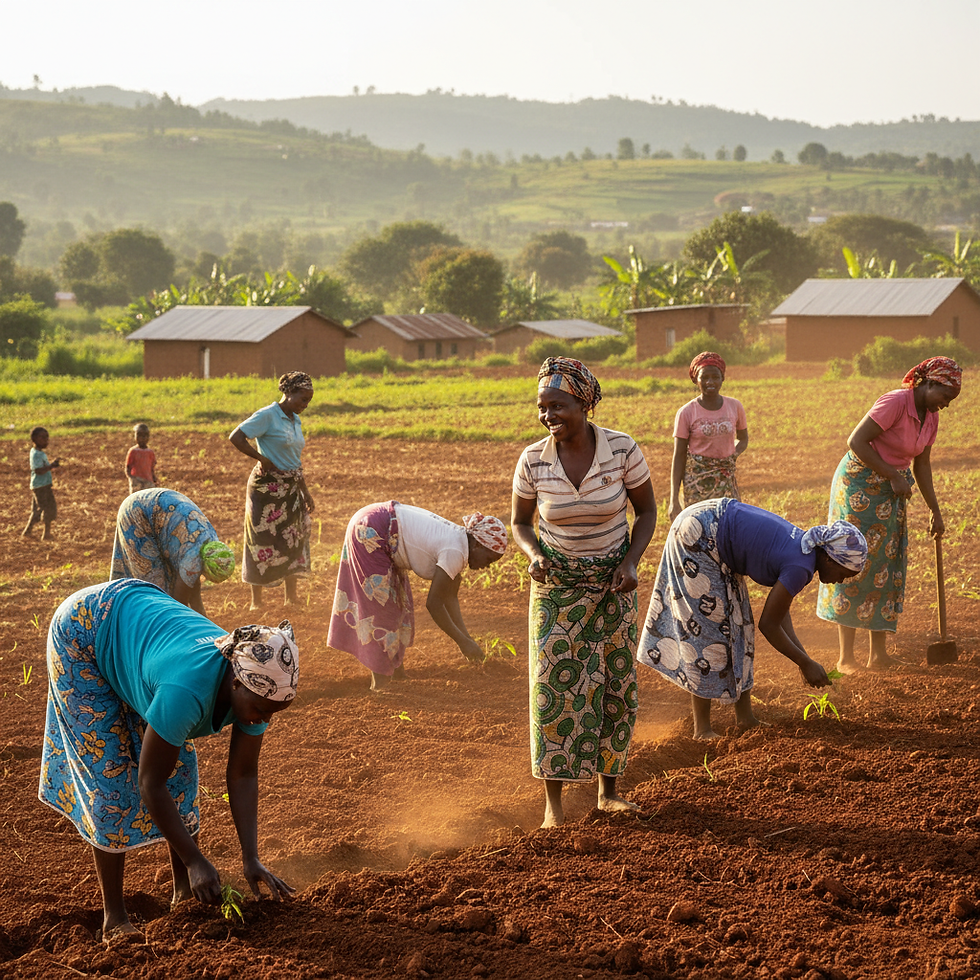
For most of Sierra Leone's history, women have had no formal right to own, inherit, or manage land under customary law. Access depended on a husband, father, or male relative. When that relationship ended, whether through death, separation, or displacement, women frequently lost their homes and their fields.
The 2022 legislation changed this in law. Women can now own, buy, lease, and inherit land in their own names. The Devolution of Estates Act 2007 and the Gender Equality and Women's Empowerment (GEWE) Act 2022 add further protections, particularly around inheritance rights for widows.
But the law and daily life do not always move at the same pace.
In many rural communities, unwritten customary rules still carry more weight than Acts of Parliament. Local chiefs and male family heads continue to control how land is distributed and who benefits. Widows are evicted by in-laws. Women are excluded from the negotiations when companies arrive to acquire farmland. Many rural women remain unaware that the law has changed at all, and the cost of hiring a lawyer to defend their rights is beyond what most can afford.
International observers, including UN Women and UPR Info, have noted that insecure land rights remain one of the primary drivers of economic vulnerability for women in Sierra Leone. The legal architecture is in place. Making it work in practice is the next challenge.
Large-Scale Land Deals: Communities and the Cost of Investment
Since the early 2000s, Sierra Leone has attracted significant interest from foreign and domestic investors seeking land for mining, palm oil, rubber, and large-scale agriculture. The promise of jobs and development has often come with serious costs for communities on the ground.
The case of Socfin Agricultural Company in Sahn Malen, Pujehun District, is one of the most documented. Long-term lease agreements covering thousands of hectares displaced smallholder farmers from land they depended on for food and income. Community members reported inadequate compensation, exclusion from negotiations, and ongoing disputes that stretched over years. Women, who made up a large share of the farming workforce, were particularly affected.
Mining operations across Kono, Tonkolili, and the south have raised similar concerns: groundwater reduction, soil erosion, loss of agricultural land, and communities relocated without adequate resettlement plans.
The 2022 land laws were designed to address exactly these situations. The FPIC requirement means that communities must give genuine, informed agreement before land can be acquired. Forced deals are now criminal. At least 5% of the value of any land-based investment must be reserved for Sierra Leoneans.
Whether these provisions are enforced in practice remains an open question. Transparency in land transactions is still low, and affected communities often lack the legal support to hold investors accountable.
How to Register Property in Sierra Leone: A Step-by-Step Guide
Property registration in Sierra Leone is managed by the Ministry of Lands, Housing and Country Planning (MLHCP) and the Office of the Administrator and Registrar General (OARG). The process applies primarily to land in the Western Area and involves seven steps.
Step | What Happens |
|---|---|
1. Property Search | Conduct a search at the OARG to confirm ownership and check for existing debts or encumbrances on the property. |
2. Survey | A licensed surveyor produces a survey plan, which is authenticated by the Director of Surveys and Lands. |
3. Deed Preparation | A legal practitioner drafts the conveyance or lease agreement between the buyer and seller. |
4. Tax Clearance | The seller obtains a tax clearance certificate from the National Revenue Authority (NRA) confirming no outstanding taxes. |
5. Stamping | The deed is stamped at the NRA and stamp duty is paid. This is calculated as a percentage of the property value. |
6. Registration | The stamped deed and authenticated survey plan are submitted to the OARG for formal registration and entry into the public record. |
7. Title (Coming Soon) | The government is transitioning to a title registration system. The first official land titles under the new system were scheduled for distribution from June 2025. |
The full process typically takes around 56 days and costs approximately 10 to 11% of the property's value in stamp duty and registration fees, excluding legal and surveying costs. Sierra Leone ranked 169th out of 190 countries for ease of registering property in the World Bank's final Doing Business report in 2020, reflecting how difficult and expensive the process remains for ordinary people.
The government, with support from the World Bank through the Sierra Leone Land Administration Project (SLLAP), is working to digitize the process and reduce both the time and cost involved.
Key Institutions You Should Know
National Land Commission (NLC)
The central body for land governance in Sierra Leone. It manages state lands, develops land policy, oversees dispute resolution, and coordinates district and village land committees across the country.
Ministry of Lands, Housing and Country Planning
The government ministry responsible for land policy, housing, and physical planning. It supervises the NLC, the Surveys and Lands Division, and the overall implementation of the 2022 land laws.
Office of the Administrator and Registrar General (OARG)
The official registry where property deeds are filed and made part of the public record. All legal transfers of property in the Western Area must pass through this office.
National Revenue Authority (NRA)
Responsible for collecting stamp duty on property transactions and issuing tax clearance certificates. The government is also transitioning land tax management fully to the NRA to improve transparency.
Village Area Land Committees
Local bodies established under the 2022 laws to manage land matters at the community level. They are the first point of contact for land disputes and decisions in rural areas, and must include at least 30% women by law.
The Ongoing Challenges
The 2022 laws represent genuine progress. But laws alone do not change systems. Several deep challenges remain.
Implementation is slow and uneven
The National Land Commission and local land committees are still being set up across many districts. Sensitization campaigns are ongoing, but large parts of the population, particularly in rural areas, remain unaware of the new laws. Without functioning institutions at the local level, the rights on paper cannot be exercised in practice.
Customary practices persist alongside statutory law
In many communities, decisions about land are still made by chiefs and male elders following traditions that predate independence. These informal systems are deeply embedded in social life and are not easily displaced by legislation. The gap between what the law says and what happens in a village is often wide.
Registration is costly and inaccessible
At 10 to 11% of property value in fees alone, formal registration is out of reach for many Sierra Leoneans. Most land in the provinces has never been formally registered. Unregistered land is harder to defend in court, harder to use as collateral, and easier to lose in a dispute. Digitalisation efforts are underway, but progress is slow.
Judicial integrity and enforcement
The IMF and World Bank have both flagged concerns about judicial integrity and contract enforcement in Sierra Leone's land sector. When disputes reach the courts, outcomes are not always predictable or consistent. Specialized land committees created under the 2022 laws are intended to reduce reliance on the regular court system, but they are still being established.
Large-scale investment and community power imbalances
Even with FPIC requirements in place, communities negotiating with well-resourced mining or agribusiness companies often lack independent legal advice or negotiating capacity. The power imbalance makes truly free and informed consent difficult to achieve in practice.
What This Means for You
If you are buying property
Always conduct a search at the OARG before paying any money to confirm the seller is the legal owner and the property is free of encumbrances.
Use a qualified lawyer to prepare and review all documents.
Ensure your deed is stamped and registered. An unregistered deed leaves you legally exposed.
Budget for stamp duty (around 10% of property value) in addition to the purchase price.
If you live on or use customary land
The 2022 laws give your community legal standing. You have the right to be consulted and to give or withhold consent before any large-scale acquisition of your land.
Women have an equal legal right to own, use, and inherit land. If you face discrimination, this can be challenged through the National Land Commission or the courts.
Contact your district land committee or a civil society organization like Green Scenery or Namati Sierra Leone if you are involved in a land dispute.
The Bottom Line
Sierra Leone's land governance system is in the middle of a significant transition. The 2022 land laws are among the most progressive on the continent, granting communities legal control over their land and women equal rights to ownership for the first time. But the gap between legislation and lived reality remains wide, particularly in rural areas where customary practices, limited institutions, and unequal power dynamics still shape who gets what.
For citizens, the key is awareness. Knowing your rights under the new laws is the first step to being able to use them. For policymakers, the work now is implementation: getting land committees functioning, making registration affordable, and ensuring that the protections on paper reach the people who need them most.
This article is for public information purposes only and does not constitute legal advice. For guidance on a specific land matter, consult a qualified legal practitioner or contact the National Land Commission.
The Salone Standard is an independent public information platform focused on systems understanding, public awareness, and practical resources.
Share Your Experience
We document experiences and explain public systems to improve clarity and access to information. If you have lived experience related to systems, services, relocation, investment, or public processes connected to Sierra Leone, you may submit it for review and documentation.
Submissions are reviewed as part of TSS's public information and systems documentation process. Where used, personal details may be anonymized unless explicit permission is granted.
Email: thesalonestandard@gmail.com
THE SALONE STANDARD • THESALONESTANDARD.COM
Independent public information platform for Sierra Leone.

Comments